Why Do My New-Construction Gutters Keep Overflowing?
Brand-new gutters should not overflow during ordinary rainfall, but they can struggle during Bluffton’s intense thunderstorms or tropical downpours if the drainage system is undersized, improperly installed, or poorly designed for the roof. In many cases, the issue isn’t that the home is new, it’s that roof runoff is reaching the gutters faster than the system can safely carry and discharge it.
Many Bluffton homeowners are surprised when they see water pouring over the edge of the gutters on a house that was completed only months earlier. Because everything is new, the natural assumption is that the drainage system should work perfectly for years without attention. When the gutters overflow during the first summer thunderstorm, many owners begin wondering whether something was installed incorrectly or whether the builder overlooked an obvious problem.
Sometimes the builder assures the homeowner that heavy rain simply overwhelms every gutter system. Other times, homeowners are told to wait until the house settles or to monitor the issue for another season. While every drainage system has limits during exceptionally intense rainfall, recurring overflow on a new home should never be dismissed without understanding why it is happening. A properly functioning gutter system should safely manage the vast majority of rain events the home is expected to experience.
Throughout Bluffton’s newer communities—from Buckwalter Parkway and New Riverside to Lawton Station, Hampton Hall, and other rapidly growing neighborhoods—modern homes often feature larger roof surfaces, multiple roof valleys, steep architectural rooflines, and complex elevations. These design features create attractive homes, but they also generate far more concentrated roof runoff than many homeowners realize.
The Problem Usually Isn’t That the Gutters Are New
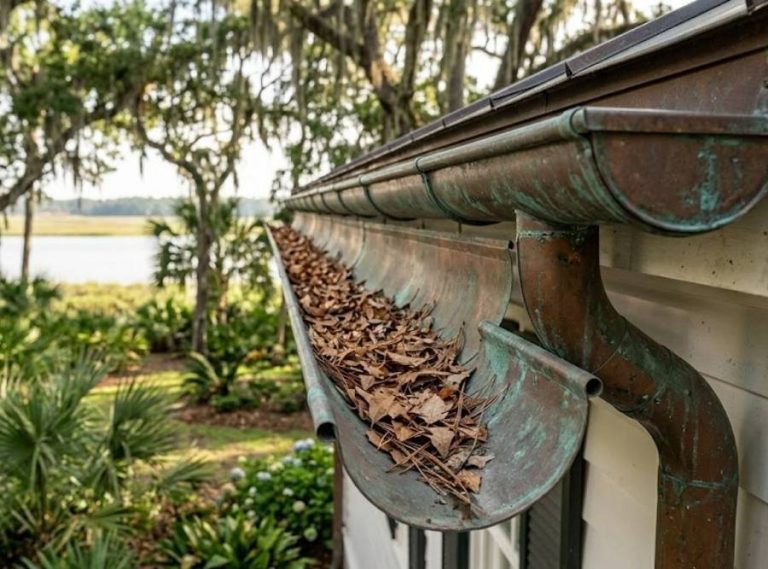
One of the biggest misconceptions is that overflowing gutters must be clogged with leaves. On older homes, accumulated debris is often the first thing to inspect. On a newly constructed home, however, recurring overflow during the first rainy season frequently points toward a different type of problem.
Because there has been little time for live oak leaves, pine needles, or Spanish moss to accumulate, the gutters themselves may appear completely clean. Water still pours over one section, rushes behind the gutter, or overshoots the front edge during heavy rainfall. This leads homeowners to believe the gutters are defective when, in reality, the issue may involve how the entire roof drainage system was designed.
Every roof collects rainfall over a large surface area and concentrates that water into relatively small gutter channels. If too much water reaches one section too quickly, the gutter can exceed its carrying capacity even though nothing is technically blocked. Likewise, if water cannot exit through the downspouts as quickly as it enters the gutter, the trough begins filling faster than it can empty.
The important point is that new gutters can overflow for reasons entirely unrelated to maintenance. The question becomes whether the system was designed to match the roof, the rainfall intensity, and the way water naturally flows across that particular home.
Bluffton’s Weather Is Harder on Roof Drainage Than Many Standard Designs
Bluffton’s climate creates conditions that expose drainage weaknesses much sooner than homeowners in many other regions experience. Summer thunderstorms often produce extremely intense rainfall over short periods, while tropical systems can deliver prolonged heavy rain accompanied by strong winds that alter how water leaves the roof.
Many builder-installed gutter systems satisfy minimum construction requirements and perform adequately during average rainfall. The challenge appears when the Lowcountry experiences one of its typical afternoon downpours. Large roof areas begin shedding enormous volumes of water almost instantly, particularly on steep roof slopes where runoff accelerates rapidly toward the gutter.
Wind-driven rain creates additional challenges. Water may not always fall straight into the gutter. During severe weather, rainfall can strike the roof from different angles, increasing runoff velocity and occasionally causing water to overshoot sections of the gutter entirely. Roof valleys intensify the problem even further by funneling water from multiple roof planes into one concentrated location.
These environmental conditions explain why homeowners often report that everything appears normal during light rain but overflows every time a significant thunderstorm passes through Bluffton. The drainage system may appear acceptable during moderate weather while struggling under the rainfall conditions that occur several times each year throughout the Lowcountry.
Roof Valleys Are Often Where New Construction Problems First Appear
If homeowners watch their gutters during a storm, they frequently notice that only one section overflows. Rather than seeing water spilling along the entire roofline, the overflow usually begins beneath a roof valley or where several roof slopes converge into the same gutter section.
Roof valleys collect runoff from multiple roof surfaces simultaneously. Instead of spreading water evenly across the gutter system, they concentrate large volumes into a relatively small area within seconds of heavy rainfall beginning. Even when the rest of the gutter system functions normally, that single location may temporarily receive more water than the gutter or outlet can discharge efficiently.
Builders sometimes install splash guards near these high-flow locations to help contain fast-moving water, but splash guards alone cannot compensate for every drainage design issue. If the gutter itself lacks sufficient capacity, if the outlet is undersized, or if the downspout cannot move water away quickly enough, overflow may continue despite the additional protection.
This is why homeowners often describe one corner of the house behaving completely differently from every other elevation. The issue is frequently tied to how the roof collects water rather than the condition of the gutter itself.
Builder-Grade Doesn’t Always Mean Designed for Bluffton’s Rainfall
Most new homes are built to meet applicable building requirements, but meeting minimum construction standards is not necessarily the same as optimizing a drainage system for Bluffton’s weather patterns and the specific roof design of an individual home.
Many production homes receive standard 5-inch K-style gutters because they satisfy the builder’s specifications for a broad range of houses. On smaller homes with relatively simple rooflines, these systems often perform very well. On larger homes with steep roof pitches, expansive roof areas, multiple valleys, or complicated architectural designs, however, the same gutter size may have far less margin during intense rainfall.
Downspout placement is equally important. A gutter may technically have sufficient capacity, but if water must travel a long distance before reaching the nearest outlet, the trough can temporarily fill faster than it drains. Likewise, too few downspouts may slow discharge even though the gutter itself remains properly installed.
None of this automatically means the builder made a mistake. Every home should be evaluated individually. The important point is that homeowners should not assume a drainage system is ideally matched to their specific roof simply because it was installed during construction. Performance during Bluffton’s heavy summer storms ultimately provides the best indication of whether the design is working as intended.
Overflow Doesn’t Always Mean the Gutters Need Cleaning
When a homeowner sees water pouring over the gutter edge, the first instinct is often to schedule a cleaning. While routine maintenance is essential over the long term, cleaning is not always the solution during a home’s first year.
Construction debris can occasionally create partial outlet restrictions. Small pieces of roofing material, nails, shingle granules, or other leftover debris sometimes remain inside gutters or downspouts after construction and should certainly be removed. However, many new-construction overflow problems occur even when the gutters are essentially free of debris.
Other installation-related factors may deserve closer attention. Improper gutter pitch can leave water standing in portions of the system after rain has ended. Minor installation tolerances may prevent water from flowing efficiently toward the outlet. In some situations, the drip edge directs water behind the gutter instead of into it, causing homeowners to believe the gutter is overflowing when the runoff is actually bypassing the system altogether.
Because several different conditions can produce similar symptoms, the safest approach is to identify exactly where the water begins leaving the intended drainage path before assuming maintenance alone will solve the problem.
Improper Gutter Pitch Can Cause Overflow on a Brand-New Home
A new gutter system can look perfectly straight from the ground while still having sections that do not drain correctly. Gutters need a slight, controlled pitch toward their outlets so water continues moving instead of collecting inside the trough. When the slope is too shallow, inconsistent, or directed away from a downspout, water can remain trapped until the gutter fills and spills over during the next period of heavy rainfall.
Standing water after a storm is one of the clearest signs that pitch may be part of the problem. Homeowners may hear dripping long after the rain has ended or notice one portion of the gutter holding water while nearby sections have already drained. During Bluffton’s humid weather, this retained water also keeps small amounts of construction debris, pollen, leaves, and shingle granules wet, allowing them to compact around outlets much sooner than expected.
Long gutter runs are particularly vulnerable because even a small installation inconsistency can create a low point. As the new home settles, subtle movement in the fascia or gutter hangers may make that low section more noticeable. The gutter may continue performing during light rain but overflow when a strong summer storm sends water into the system faster than it can travel past the low area.
Re-pitching a gutter should not be treated as a casual do-it-yourself adjustment. Changing one section without evaluating the full run can move the standing-water problem somewhere else, strain hangers, or create a visible wave along the roofline. The correct adjustment depends on the gutter length, outlet locations, fascia condition, and the amount of runoff the section receives.
Too Few Downspouts Can Restrict an Otherwise Adequate System
Gutter capacity is only part of the equation. Water must also be able to leave the system quickly enough through the outlet drops and downspouts. A large gutter attached to too few downspouts can still overflow because the system fills faster than the available outlets can discharge the water.
This commonly appears on long roof elevations where one downspout is expected to handle runoff from a large area. During moderate rainfall, the arrangement may seem completely functional. During a tropical downpour, however, water begins backing up from the outlet and spreading through the gutter until it spills over at a corner, valley, or low point.
Outlet size also matters. The opening connecting the gutter to the downspout can become a hydraulic restriction even when the visible downspout seems large enough. Small pieces of construction material, heavy shingle granules, sealant, or early organic debris may partially cover that opening, slowing the system without creating an obvious clog. The homeowner sees a clean gutter but still hears gurgling or notices delayed drainage.
Adding a properly located downspout may improve performance by shortening the distance water must travel and distributing runoff across more outlets. However, the new discharge point also needs somewhere appropriate to send the water. A downspout that empties directly beside the foundation or into an already saturated flower bed can replace a roofline overflow problem with foundation moisture and landscape erosion.
Water May Be Overshooting the Gutter Instead of Filling It
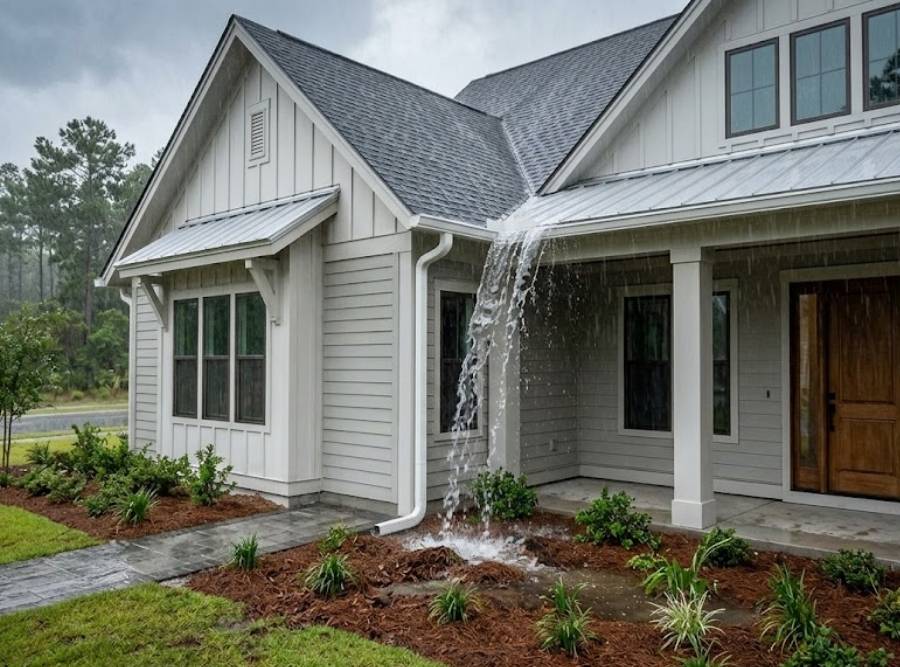
Not every apparent overflow is water rising over the front edge of a full gutter. On steep roofs, runoff can move so quickly that it shoots beyond the gutter before the system has an opportunity to collect it. Homeowners often describe this as a wave of water sailing over the edge, especially below roof valleys or on tall sections of a multi-story home.
Overshoot is different from a capacity problem, although both can occur at the same location. If the gutter is relatively empty while water misses it, simply increasing the downspout capacity may not address the issue. The evaluation needs to consider roof pitch, gutter position, drip-edge configuration, valley discharge, and whether the gutter is mounted at the correct height relative to the roof edge.
Splash guards can sometimes help contain concentrated valley runoff, but their placement matters. An oversized or poorly positioned guard may redirect water behind the gutter, trap debris, or create a new obstruction. A splash guard should support the drainage design rather than compensate for an undersized or incorrectly positioned system.
Video recorded safely from the ground during rainfall can be very useful in identifying overshoot. It shows whether water is missing the gutter, filling it from below, running behind it, or backing up at an outlet. That distinction makes the eventual repair much more targeted than trying several unrelated fixes.
Water Running Behind the Gutter Points to a Different Problem
When water streaks down the fascia or siding behind a new gutter, the system may not actually be overflowing from the front. Water could be entering between the roof edge and the back of the gutter because the drip edge, apron flashing, or gutter position is not directing runoff into the trough as intended.
This condition is easy to overlook because the visible symptoms resemble a leaking or overflowing gutter. Homeowners see wet fascia, stained soffits, or water running down the wall and naturally assume the gutter is full. A closer inspection may reveal that the gutter is draining normally while part of the roof runoff bypasses it entirely.
Repeated wetting behind the gutter deserves prompt attention. The fascia and roof-edge materials were not designed to remain saturated after every storm, especially in Bluffton’s high humidity. Moisture can linger behind the gutter where sunlight and airflow are limited, gradually contributing to staining, deterioration, loose fasteners, and damage that is much more expensive than correcting the original water path.
Applying caulk to visible seams without identifying where the water begins is rarely a lasting solution. Sealant may temporarily cover one gap while trapping moisture elsewhere or redirecting water into the soffit. The roof edge, flashing, fascia, and gutter need to be evaluated together because each component affects how runoff enters the drainage system.
Document the Overflow Before the Builder Warranty Expires
When gutter problems appear during the first year of ownership, homeowners should document them rather than relying only on verbal conversations with the builder. Photos and videos taken during multiple rain events can show the exact location, rainfall behavior, and resulting erosion or water exposure. Written communication creates a record of when the issue was first reported and how frequently it has occurred.
The documentation should distinguish between ordinary dripping and recurring system failure. Useful details include whether the gutter was visibly clean, where the overflow began, which downspouts were discharging, how long water remained in the trough, and whether the issue affected landscaping, siding, porches, garages, or foundation areas. Images taken after the storm can also capture standing water, washed-out mulch, damp fascia, or staining that may not be visible while rain is falling.
A builder warranty does not automatically guarantee coverage for every drainage concern, and warranty language varies. However, waiting until the coverage period has passed can make it more difficult to establish that the problem began shortly after construction. Requesting an inspection early gives the builder an opportunity to review installation-related concerns before repeated overflow creates additional damage.
Homeowners should avoid making significant alterations before the original system has been documented and evaluated. Randomly bending hangers, adding homemade splash guards, or re-pitching sections may complicate the assessment and make it harder to determine whether the original installation was responsible.
Treating the Erosion Without Fixing the Runoff Creates a Repeating Cycle
Overflowing gutters often become most frustrating when they repeatedly destroy new landscaping. Homeowners replace mulch, refill washed-out flower beds, add decorative stone, or repair shallow trenches beneath the roofline, only to watch the same areas erode during the next major storm.
The landscaping damage is a symptom of concentrated water, not the underlying cause. Until the roof runoff is collected and discharged correctly, cosmetic repairs around the home will remain vulnerable. Adding more mulch or soil may even make matters worse if the new material raises the grade against siding, blocks drainage paths, or directs water toward a porch or crawlspace.
Downspout extensions can help when water is leaving the gutter correctly but discharging too close to the home. They are less useful when the gutter is overflowing before water reaches the downspout. This is why the complete path needs to be examined—from the roof slopes and valleys to the gutter, outlet, downspout, and final discharge location.
A successful correction should reduce both the visible overflow and the secondary effects around the home. Flower beds should no longer receive waterfall-like runoff, mulch should remain in place during ordinary storms, and foundation areas should dry normally instead of remaining saturated after each rainfall.
Ignoring Early Overflow Can Damage a Home That Is Still Practically New
New-construction gutter overflow often begins as an inconvenience rather than an obvious building emergency. Water pours over one corner, mulch shifts, and the fascia looks damp after especially hard rain. Because the house is new, homeowners may assume the materials can tolerate the exposure or that the issue will somehow improve as the property settles.
Repeated saturation rarely corrects itself. Water spilling over the same section can loosen soil, keep foundation areas wet, stain siding, encourage algae on walkways, and expose fascia and soffits to moisture. When the gutter remains overloaded, hangers can loosen and the trough may begin pulling away from the fascia, creating more space for water to run behind the system.
Crawlspace homes are especially sensitive to poorly managed runoff. Water does not need to enter the living area to create a moisture concern. Persistent saturation around the foundation can increase dampness beneath the home, contribute to musty odors, and place more strain on any crawlspace moisture-control system already in place.
An early correction may involve a relatively limited adjustment, such as clearing an outlet, correcting pitch, installing a properly designed splash guard, enlarging a high-flow section, or adding an appropriately located downspout. Once water damage spreads to wood, siding, landscaping, or interior materials, the project becomes significantly more involved.
The Right Fix Depends on How the Water Is Failing
There is no single upgrade that solves every new-construction gutter problem. Some homes need a minor installation correction, while others have a system that was not sized or configured for the roof’s runoff patterns. Replacing every gutter without diagnosing the failure may be unnecessary, but repeatedly cleaning a system with a design deficiency will not produce lasting results either.
If water consistently backs up inside a clean gutter, the evaluation should consider gutter capacity, outlet size, pitch, and downspout spacing. If water shoots over the front edge while the gutter remains mostly empty, roof velocity and gutter positioning deserve more attention. If runoff appears behind the gutter, the roof-edge flashing and drip-edge relationship should be examined. Overflow isolated below a large valley may require changes specifically designed for that concentrated flow point.
In some cases, upgrading from 5-inch to 6-inch gutters may provide the additional capacity a large or complex roof requires. That decision should be based on roof area, slope, valley concentration, outlet capacity, and observed performance rather than the assumption that bigger is always better. A larger trough connected to the same restricted outlets may continue producing similar results.
The best solution corrects the actual bottleneck and ensures the water has a safe route after leaving the roof. That may involve a combination of gutter, downspout, and ground-level drainage improvements rather than one isolated product change.
New Gutters Should Be Evaluated by Performance, Not Age
A brand-new gutter system can still be poorly matched to a home. Age tells homeowners how recently the components were installed, but it does not confirm that the system has the right capacity, pitch, outlet placement, or relationship with the roof edge. Performance during Bluffton’s real weather conditions is a much more useful measure.
Homeowners should not panic over a single unusual storm, but recurring overflow in the same locations deserves investigation. When every strong thunderstorm produces a waterfall over a valley, wet fascia, washed-out landscaping, or standing water beside the foundation, the drainage system is showing a consistent failure pattern.
At Spartina Seamless Gutters, we evaluate new-construction gutter problems by following the water through the entire system. We look at roof size and complexity, valley discharge, gutter capacity, pitch, downspout placement, outlet restrictions, flashing relationships, and where the runoff travels after reaching the ground.
If the gutters on your new Bluffton home overflow despite appearing clean, an inspection can help determine whether the cause is construction debris, installation, system sizing, concentrated roof runoff, or a combination of factors. Correcting the problem while the home and gutter system are still new can help protect the fascia, soffits, siding, landscaping, crawlspace, and foundation from years of repeated water exposure.

Spartina Seamless Gutters leads the Lowcountry in custom seamless gutter fabrication, micro-mesh leaf protection, and exterior water management. Serving residential and commercial properties across Jasper and Beaufort counties, their experienced technicians deliver actionable insights on storm drainage, soffit care, and protecting your home against severe coastal weather.