Do Historic Homes in Isle of Hope Need Special Gutter Cleaning Care?
Yes. Historic homes in Isle of Hope often require a more careful approach to gutter cleaning because they may have original copper, half-round, or box gutter systems, aging wood trim, and decorative architectural details that can be damaged by aggressive cleaning methods. Proper maintenance focuses on preserving historic materials while ensuring the gutter system continues protecting the home from water damage.
Owning a historic home in Isle of Hope comes with responsibilities that extend far beyond maintaining its appearance. Many of these homes have stood beneath the community’s iconic live oaks for generations, weathering countless coastal storms while retaining architectural features that make them unlike modern construction. While homeowners often focus on preserving original windows, woodwork, porches, and roofing, one of the most important preservation systems quietly works along the roofline every time it rains. The gutters are responsible for moving thousands of gallons of water safely away from the home, and when they are not cleaned or maintained properly, the resulting damage often affects some of the most historically valuable parts of the property.
Unlike many newer homes throughout the Savannah area, historic residences frequently include gutter systems that deserve preservation rather than replacement. Original copper gutters, traditional half-round profiles, decorative brackets, built-in box gutters, and hand-soldered joints were designed differently than modern seamless aluminum systems and require different maintenance practices. Cleaning them aggressively simply because they are clogged can create problems that are far more expensive than the debris that caused the blockage in the first place.
Throughout Isle of Hope, particularly along Bluff Drive, around the historic waterfront, and throughout the tree-lined streets surrounding the Isle of Hope Historic District, mature live oaks continually shed leaves while Spanish moss and pine needles collect throughout the year. Combined with the area’s high humidity, frequent summer thunderstorms, and coastal weather, these conditions create one of the most demanding environments for historic gutter systems in coastal Georgia. Keeping them clean is important, but preserving the integrity of the original drainage system is equally important.
Historic Gutters Are Often Part of the Home’s Original Architecture
One of the biggest misconceptions homeowners have is assuming gutters are simply replaceable accessories attached to the edge of the roof. That may be true for many modern homes, but it is often not the case with historic properties. On older residences, the gutter system may have been intentionally designed as part of the home’s architectural character, using materials and craftsmanship that are difficult—or sometimes impossible—to duplicate today.
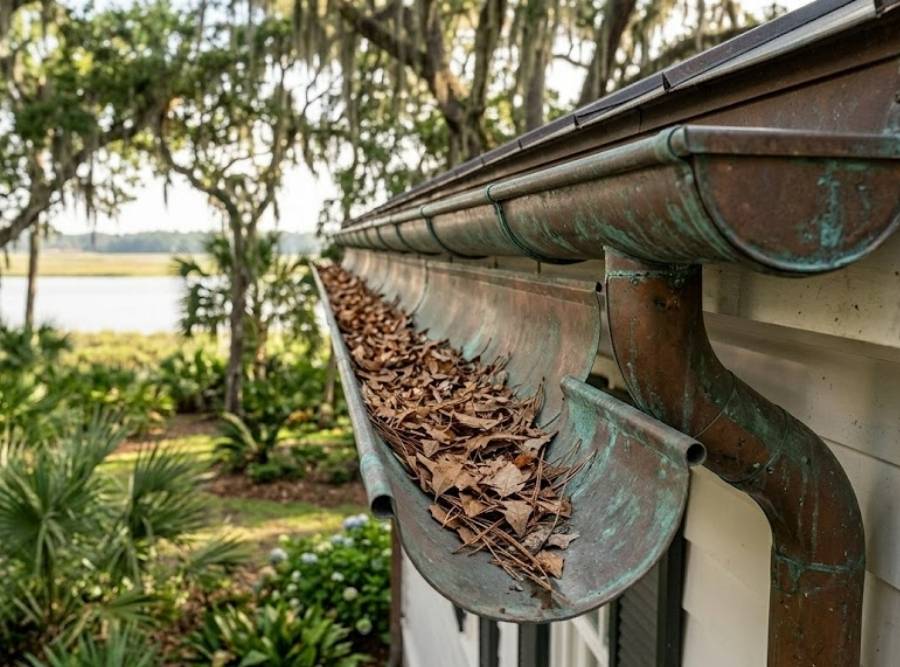
Many historic homes in Isle of Hope feature elegant half-round copper gutters supported by decorative brackets that complement the home’s period architecture. Others incorporate box gutters that are built directly into the roof structure rather than hanging from the fascia. These systems perform the same essential function as modern gutters, but they do so with construction methods that require considerably more care during cleaning and inspection. A technician who approaches every home the same way may unknowingly place unnecessary stress on decorative supports, loosen aging solder joints, or overlook hidden drainage areas that cannot be seen from the ground.
Historic copper systems also change naturally over time. The green or brown patina that develops on copper is not dirt, corrosion, or something that should be scrubbed away. It forms as part of the metal’s natural aging process and actually helps protect the copper beneath it. Unfortunately, some homeowners mistakenly believe bright, polished copper is healthier than weathered copper, leading to unnecessary cleaning methods that remove this protective surface. Preservation-conscious maintenance recognizes the difference between removing debris that restricts water flow and disturbing materials that have successfully protected the home for decades.
Understanding these distinctions is one of the reasons gutter cleaning on a historic property should never be viewed as routine maintenance alone. It is also an exercise in preserving the building itself.
Cleaning Historic Gutters Is About Protecting More Than the Gutters
When people think about clogged gutters, they usually picture water overflowing onto the ground. On a historic home, however, the consequences often extend much further because the surrounding construction is frequently more vulnerable than what is found on modern buildings. Many older homes contain original wood fascia, decorative cornices, handcrafted trim, and architectural details that have survived for generations. Allowing water to repeatedly overflow or run behind the gutter exposes those features to prolonged moisture that they were never intended to endure.
What begins as a layer of wet oak leaves trapped inside a gutter can slowly become a preservation issue. Debris holds moisture against wood trim, reducing its ability to dry between storms. Paint begins bubbling along the roofline, small areas of deterioration develop behind the gutter where they remain hidden from view, and over time the moisture may work its way into soffits, wall cavities, or even interior finishes. Homeowners sometimes discover ceiling stains or deteriorating woodwork long before realizing the original source of the problem was a gutter that simply had not been cleaned properly.
The shaded canopy that makes Isle of Hope so distinctive also contributes to this process. Live oaks provide beautiful streetscapes, but they continuously drop leaves throughout much of the year instead of during one short autumn season. Spanish moss can gradually work its way toward downspout openings, while pine needles weave together into dense mats that trap additional debris. Because many historic homes sit beneath mature trees that have grown for decades, their gutter systems often collect material far more frequently than homes in newer developments with younger landscaping.
This constant cycle of moisture and organic debris is exactly why preservation-minded maintenance focuses on routine cleaning before blockages become severe. Preventing water from remaining trapped against historic materials is one of the simplest ways to reduce the likelihood of expensive restoration work later.
Why Older Gutter Systems Require a Different Cleaning Approach
The techniques that work well on a modern seamless aluminum gutter are not always appropriate for a century-old drainage system. Historic gutters often include hand-soldered seams, older attachment methods, decorative brackets, and materials that have naturally aged over many decades. Cleaning these systems requires an understanding of how they were built and where they are most vulnerable rather than relying on speed or force.
For example, aggressive pressure washing may appear to remove debris quickly, but it can also place unnecessary stress on older solder joints that have already experienced decades of seasonal expansion and contraction. Similarly, scraping compacted debris with rigid metal tools may damage the protective surface of aged copper or create unnecessary wear on historic materials that have otherwise remained structurally sound. Even something as simple as leaning a ladder incorrectly against an older gutter system can place excessive pressure on decorative brackets or aging wood trim that was never designed to support that kind of concentrated weight.
Another important difference involves inspection. Modern gutter cleaning often focuses primarily on removing leaves and confirming that water flows through the downspouts. Historic systems require a more comprehensive evaluation because many developing problems are hidden behind the visible gutter itself. Minor separation at soldered joints, moisture collecting behind decorative trim, early signs of wood deterioration, or debris accumulating inside box gutter systems can all exist long before homeowners notice obvious overflow.
This is why we believe gutter cleaning should never be treated as an isolated maintenance task. On historic homes, every cleaning also becomes an opportunity to evaluate the health of the entire roof-edge drainage system and identify preservation concerns before they develop into structural repairs.
One of the Most Overlooked Problems Is What Happens Inside the Downspouts
Many homeowners assume that if the visible gutter channel is free of leaves, the system is ready for the next storm. In reality, one of the most common causes of recurring overflow on historic homes is a partially obstructed downspout that continues restricting water flow even after the gutter itself has been cleaned.
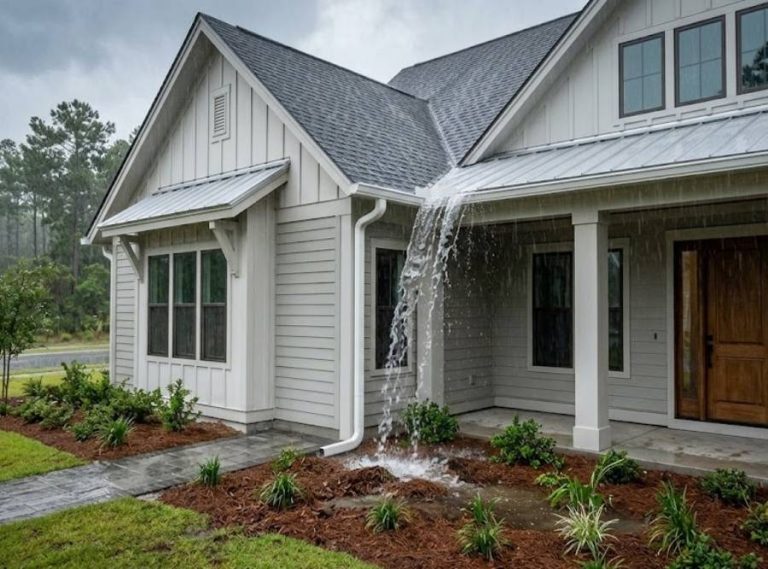
This problem is especially common beneath large live oaks where leaves, pine needles, small twigs, seed pods, and Spanish moss gradually work together to form dense blockages inside vertical downspouts or collector boxes. During lighter rainfall, these partial obstructions may go unnoticed because the water drains slowly enough to prevent immediate overflow. Once one of Isle of Hope’s intense coastal thunderstorms arrives, however, the restricted outlet cannot move water quickly enough, causing the gutter to fill until it spills over the roof edge despite appearing clean only days earlier.
Historic homes with box gutters or more intricate drainage layouts require even greater attention because blockages are not always visible from above. A preservation-conscious inspection involves confirming that every component of the drainage system from roof valleys to downspouts and discharge points is functioning together rather than assuming debris removal alone has solved the problem.
The Value of Cleaning Historic Gutters Before Problems Become Visible
One of the greatest advantages of routine gutter cleaning is not simply removing leaves or restoring water flow. It is the opportunity to identify developing problems while they are still relatively small and before they begin affecting the historic character of the home. By the time water stains appear on interior ceilings or paint begins peeling beneath the roofline, moisture has often been present for much longer than homeowners realize.
During routine maintenance, we frequently observe subtle warning signs that would otherwise go unnoticed from the ground. Decorative brackets may begin loosening after decades of supporting the gutter system, soldered joints can develop fine separations from years of seasonal expansion and contraction, and small amounts of standing water may indicate that debris has accumulated inside a box gutter or partially blocked a downspout. None of these issues necessarily require major repairs if they are identified early, but each can become significantly more expensive if left through another season of heavy rainfall.
Historic homes also have fewer opportunities to “hide” moisture problems. Original wood trim, handcrafted cornices, and traditional construction methods often respond differently to prolonged moisture than modern synthetic building materials. Rather than allowing water damage to quietly affect replaceable components, historic homes frequently show deterioration in architectural features that contribute directly to the property’s character and value. Preserving those features begins with keeping water moving exactly where it belongs.
Throughout Isle of Hope, many homeowners schedule gutter cleaning before the height of hurricane season and again after periods of heavy leaf drop because they understand that coastal weather can place enormous demands on an aging drainage system in a very short period of time. Preventive maintenance is rarely about preparing for an average rainfall. It is about making sure the system is ready for the storms that test it the most.
A Common Misconception About Historic Copper Gutters
One misunderstanding we occasionally encounter is the belief that historic copper gutters should either be polished until they look new or replaced simply because they have changed color over time. Neither assumption reflects how copper is designed to perform.
Copper naturally develops a patina as it ages. Depending on environmental conditions, that patina may appear brown, bronze, or eventually green. Far from indicating failure, this weathered surface actually serves as a protective layer that helps the metal resist further deterioration. Attempting to aggressively remove it for cosmetic reasons can expose fresh copper unnecessarily and interfere with the material’s natural aging process.
The condition that deserves attention is not the color of the copper but how effectively the system manages water. Soldered joints, brackets, outlets, and downspouts should all be evaluated for proper performance, while debris should be removed carefully enough to preserve the integrity of the historic materials. The objective is not to make a century-old gutter look brand new. The objective is to help it continue performing the job it has done for decades while respecting the craftsmanship that went into its original construction.
The same philosophy applies to other historic drainage systems as well. Box gutters, decorative leader heads, and custom architectural details should be maintained with an understanding of how they function rather than treated as though they were interchangeable with modern components. Preservation-conscious cleaning recognizes that every historic home tells a different story, and its drainage system often reflects that individuality.
Why Experience Matters More on Historic Properties
Cleaning gutters on a recently built home and cleaning gutters on a historic residence require very different perspectives. Modern systems are generally standardized, with similar materials, attachment methods, and construction techniques from one neighborhood to another. Historic homes, by contrast, often reflect decades of renovations, additions, repairs, and original craftsmanship that make every drainage system unique.
Some properties retain original half-round copper gutters supported by decorative brackets. Others include box gutters integrated into the roofline, older leader heads, or custom-built drainage details that are difficult to recognize without experience. Even neighboring homes along Bluff Drive or throughout the Isle of Hope Historic District may have completely different gutter designs despite being built during the same era. Assuming every historic home should be cleaned the same way increases the risk of overlooking hidden drainage issues or placing unnecessary stress on original materials.
Experience also changes what we look for during an inspection. Instead of focusing only on visible debris, we evaluate how water enters the gutter from roof valleys, how efficiently it exits through the downspouts, whether moisture has begun affecting surrounding woodwork, and whether aging attachment points continue providing adequate support. We pay attention to areas where leaves repeatedly collect, shaded sections where moss remains damp for extended periods, and roof edges where overflow patterns suggest developing restrictions before they become major failures.
This broader approach is particularly valuable in Isle of Hope, where mature landscaping, waterfront humidity, and frequent thunderstorms create conditions that demand more from historic drainage systems than they were originally designed to handle. Preserving those systems requires understanding both the home’s history and the environmental conditions it experiences today.
Historic Gutter Cleaning Is Really About Protecting the Entire Home
It is easy to think of gutter cleaning as seasonal maintenance, but on a historic property it serves a much larger purpose. Every time water is directed safely away from the roof edge, it protects original woodwork, decorative trim, painted surfaces, masonry, landscaping, and the structural framework that has allowed the home to endure for generations. Every time debris is allowed to remain trapped against those materials, the opportunity for hidden deterioration increases.
This is especially true throughout Isle of Hope, where the combination of mature live oaks, Spanish moss, coastal humidity, and frequent summer storms creates one of the most demanding environments for historic roof drainage systems in the region. A cleaning performed with preservation in mind does more than improve water flow. It helps extend the life of original architectural features that cannot easily be replaced and reduces the likelihood that small drainage issues will become significant restoration projects.
For homeowners who have invested in preserving a historic residence, the gutter system deserves the same thoughtful attention as every other architectural element. It may not be the first feature visitors notice, but it quietly protects many of the features they do notice every time it rains.
If your historic home in Isle of Hope has overflowing gutters, recurring leaf buildup, water staining beneath the roofline, or original copper or box gutters that have not been professionally inspected in some time, Spartina Seamless Gutters can provide preservation-conscious gutter cleaning and drainage evaluations that prioritize both performance and the long-term care of your home’s historic character.